Facebook pre

Showing posts with label PTSD. Show all posts

Friday, June 6, 2014

An Empty Vessel and the Metaphor of a Tree

Do you ever have those moments where you feel truly inspired by God and know you are on the right track? Many authors talk about writing the story God gave them. It’s a wonderful feeling as the Holy Spirit flows through your fingertips onto the page. But there’s another kind of Holy Spirit experience that’s even better than knowing it as it happens. It’s the moment you read back what you thought was a mundane, common-place scene and find the gems He left behind. That’s when you know you are being used as an Empty Vessel of the Lord. And there’s no greater feeling in the world, because the emptier you are of yourself, the more room you have for Him. And the more Him, the better!

I have many moments in my life I look back to and see God’s work in play, even times I’d put Him aside for what I’d deemed more important things. Though I’d neglected Him, He never treated me as though I were of lesser importance. I think that’s why those moments are so special to me now.

He still gives me these wonderful revelations of His presence in my life. One most recent was as I wrote the last scene of my novella, At the Edge of a Dark Forest.

In writing fiction, it’s important to get the pacing of the story just so. That way, the reader can feel they are in the moment with the character. In the final scene, my female protagonist, Carly, is going to a spot in the forest to see the male protagonist, Cole, for the first time in many months. I felt this walk in the woods needed to take a little time so the reader could feel Carly’s nervousness about seeing Cole again. I wanted to drag it out just a bit so as to heighten the suspense of what she’d find. So I added lots of details of the woods she traveled and thoughts of past moments there.

I asked myself, “What would she be thinking?”

She’d be thinking of the tree her father’s car hit when he meant to commit suicide. That was the moment where Cole and Carly’s two worlds intertwined.

“What would the tree look like now?”

I wrote the answer into the story, “New growth in broken spots and animals finding shelter in the holes.”

I added the crunch of the leaves under her feet and the exertion of the climb and ended the story. Phew! It always feels so good to type “The End” even when you know there are reams of edits to make afterwards. So I read through the scene several times, clarified points, elaborated on ideas and …

Then it hit me!

New growth in broken spots and animals finding shelter in the holes.

Wow, God!

That phrase, unbeknownst to me as I typed the words, was a perfect metaphor for Cole’s story. You see, Cole is a double amputee after having been injured from an IED in the Iraq War. Carly came into his life to provide him with her prototype prosthetics and train him how to use them.

New growth in broken spots …

But that was not the part that really shocked me. It was the last words of the sentence …

… and animals finding shelter in the holes.

I couldn’t believe my eyes. Could the metaphor be more perfect? I sobbed at the realization, because I had nothing to do with its use. It was all God … when I wasn’t looking. There’s nothing more extraordinary then the feeling of being an Empty Vessel of the Lord. Thank you, God!

Oh yeah, if you’re wondering how the animals finding shelter in the holes relates to the story, well, there’s only one way to find out <wink>.

Other Posts you might like:

God on the Line

Let Him Steal Your Show

Do You Ever Feel Your Offering Is Too Small?

Monday, April 7, 2014

Blog Tour

You may have noticed I haven't had a new blog post up in a bit. That is not to say I am not blogging. Believe me, I am blogging--just not here. I have been very busy on what we writers call a "blog tour" in order to promote my novella, At the Edge of a Dark Forest. I didn't mean to neglect you ;o).

If you'd like to see what I've been blogging about, here are the links of the tour so far:


March 3rd—“Ink from an Earthen Vessel”—Ada Brownell

            An interview about “Minions for the Mighty”

March 14th—James Callan

            Hippotherapy (therapy with horses) for disabled veterans

March 17th—Seriously Write—Annette Irby

            An Empty Vessel and a Tree—How God shows up in my manuscript


March 20th—Sweet South Blog—Natalie Monk
 
            Interview of Carly from At the Edge of a Dark Forest


 March 26th—Writing Prompts Blog—Jennifer Hallmark

            Three Questions Wednesday


            Hippotherapy (therapy with horses) for disabled veterans

March 31st—Peering Through Life’s Window—Gail Palotta

            Author Interview talking about inspiration for the novella, At the Edge of a Dark Forest


            DoesYour Man Slay Dragons for You?

April 6th—Overcoming with God—Carrie Pagels

            Author Interview talking about how God prepared me to be the mother of a son with autism.

If you'd like to see the rest as it comes along, check out the Events/Blog Tour tab above. I will be sharing more here very soon.

Thanks for stopping by.


Friday, January 17, 2014

Dark Forests and Military Service

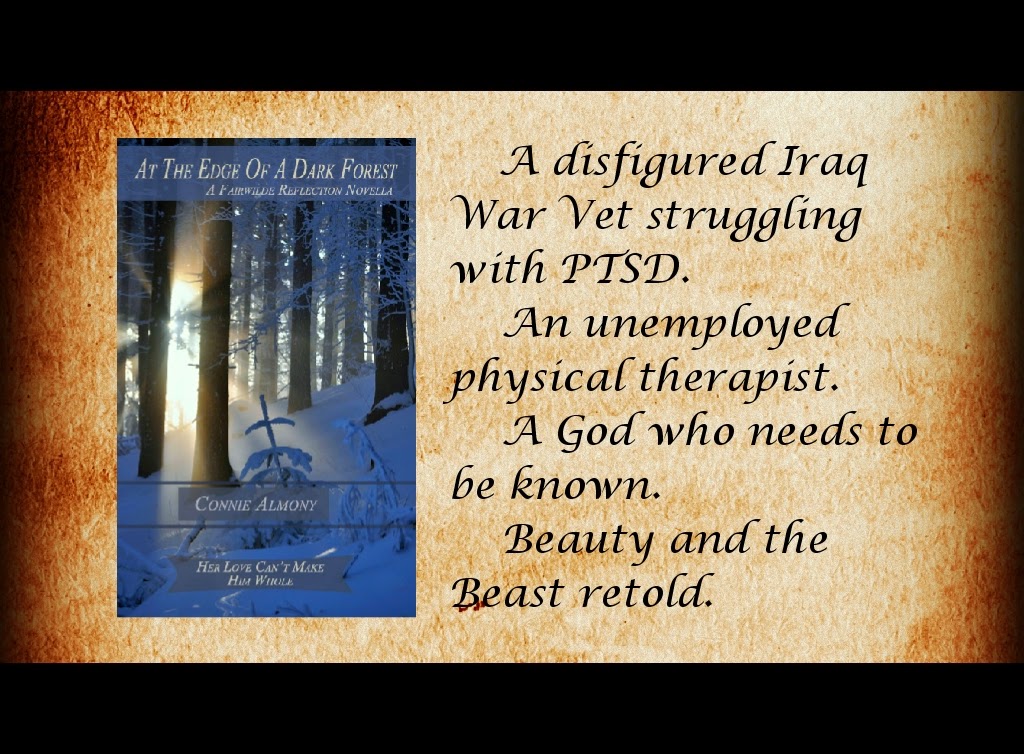
You may have noticed the background of Living the Body of Christ has changed yet again. No, this isn’t my ADD kicking into overdrive because I’m bored of the old one. It’s me celebrating the cover art of my soon-to-be-released novella, At the Edge of a Dark Forest.
Whoopie!!!

Look out, March!!!
Here’s the blurb:

Cole Harrison, a war veteran, wears his disfigurement like a barrier to those who might love him, shielding them from the ugliness inside. He agrees to try and potentially invest in, a prototype prosthetic with the hope of saving a hopeless man’s dreams.
Carly Rose contracts to live with Cole and train him to use his new limbs, only to discover the darkness that wars against the man he could become.

At the Edge of a Dark Forest is a modern-day retelling of Beauty and the Beast. Only it is not her love that will make him whole.
This endeavor started out as a series project with my critique partners (June Foster, Gail Palotta, Vanessa Riley and Mildred Colvin), but as the story grew from the inspiration of the military ministries series I did a couple of years ago, it quickly became a labor of love. You see, I have no family who fought in our most recent wars, but I have a few acquaintances whose husbands have. As I considered the men and women who’ve fought and died for my freedoms, I realized I’ve had no real “skin in the game.” This story is my small way to give something back. Additionally, I will be donating 10% of my earnings on At the Edge of a Dark Forest to Military Ministries, a subgroup of Campus Crusade for Christ. I hope it will help to bring God into the healing of our soldiers and their families.

Can you see the cross in the picture above. Tell me below.

Other posts you might like:
Broken by War, Saved by Grace

Sacrifice—No Greater Love

Friday, May 4, 2012

24 Ways to Put Military Ministry into Action


42-15560571Over the past few weeks, I’ve focused on the needs of our military members. Today, I’d like to focus on what the church can do for them and their families. These are wives without their husbands, husbands without their wives, and children missing at least one parent for long stretches of time. They need support.

As a person working in a counseling office I’ve seen families stressed by the parent or spouse who works long hours and/or goes on frequent business trips, only to come home, fried, to a spouse who’s juggled multiple burdens. This takes a toll on the marriage, the family and each individual within it.

Now, imagine if that business trip spanned months, or even years, and the stress of the “deal” was replaced by the threat of peppering bullets, bitter enemies and IEDs. A real and immediate concern for many of our citizens today.

These families need help—physical, emotional and spiritual help. They need assistance for the care of the home and family as well as the multiple burdens from the scars within.  Many churches are assisting families in important ways. Is yours one of them?

The following is a list generated mostly by Jean King, of Military Ministry (a division of Campus Crusade for Christ, International), outlining the kinds of supports given to her as a military wife, as well as what her church (and others) have done. I have also included a few ideas I picked up from discussions I had while compiling this series. Hopefully, they will spur some ideas of your own.

Basic Care
 · Help with minor car repair or maintenance for the spouse of the deployed.
 · Male member of the church helping son with Boy Scout projects.
 · Families inviting kids for pizza and game night.
 · Help with transportation to sports, school or church activities.
 · Single woman helping mothers with Christmas morning set-up.
 · Care packages for the deployed.

Emotional/Relational Care
 · Phone calls and cards of encouragement for family members and deployed.
 · Support groups for at-home spouses discussing fears and challenges; encouraging and praying.
 · Support groups for military members transitioning to civilian life.
 · Camping ministries for survivalists transitioning to the world of home and office.
· PTSD groups for those still haunted by images of war (see resources).
 · Buying flowers on Valentine’s Day.
 · Gift cards for spa days for overburdened moms.
 · Meals for overburdened moms.
 · Marriage Support groups, such as “Homebuilders Bible Study,” “Loving Your Military Man,” Making Your Marriage Deployment Ready,” and “Defending the Military Marriage.” 
· Watching kids for a Parent’s Night Out, both when deployed as well as while couple is transitioning to home life back together.

Spiritual
 · Bible studies specific to needs (see above).
 · Bible/Devotional packages for the deployed (not just those in your church, but ones who may not yet know God).
 · Prayer sheets for deployed, listing where they are, family’s name and expected date of return. But don’t forget to continue to pray after they DO return.

Military Appreciation
 · Military Appreciation dinner.
 · Youth group activities on same night, while parents are at dinner.
· Appreciation picnic.
 · Special Recognition on Veteran’s Day, Fourth of July and Memorial Day.
 · Meals brought for families when deployed returns home.

I’m sure there are many valuable ways we can support those who have risked their lives for us. Don’t stop at these!  Military Ministry is definitely a great resource. Check them out. 

Feel free to share ideas of what your church is doing in the comments below. Thank you.

Related links in this series:
 The War at Home
 Invisible Battle
 Broken by War, Saved by Grace

  Resources/Books:
 Military Ministry
 Fighting Fear: Winning the War at Home When Your Soldier Leaves for Battle, by Edie Melson
Battlefield and Blessings Iraq/Afghanistan (Stories of Faith and Courage)
 Two Wars: One Hero’s Fight on Two Fronts—Abroad and Within


http://www.amazon.com/Edge-Dark-Forest-Reflection-Reflections-ebook/dp/B00IIVIYH4/ref=sr_1_1?ie=UTF8&qid=1396871965&sr=8-1&keywords=at+the+edge+of+a+dark+forest

Wednesday, May 2, 2012

The War at Home, by Jocelyn Green

 
Today, I’m continuing my series on Military Ministries and I want to thank Jocelyn Green again for sharing another excerpt from her bbiraqlarge_1251book, Stories of Faith and Courage from the War in Iraq & Afghanistan. These have truly been a blessing.

The War at Home
 
Andrea Westfall, Oregon Army National Guard, Kuwait and Iraq, 2002-2003

When Andrea Westfall came home from her nine-month deployment to Kuwait and Iraq as a flight medic in May 2003, she knew something had changed within her.

“I reacted to loud noises,” she remembered. “I no longer felt safe and always watched doors. I didn’t like to be around people—large crowds were awful for me. I thought I was going crazy, but it wasn’t until a year after I got home that it was bad enough to get help. I was self-medicating, getting drunk every night. I was miserable and I wanted to feel anything different than the hell I was in.”

Westfall was diagnosed with post traumatic stress disorder and went to the nearby VA Center for treatment. But she knew that wouldn’t solve everything. For her nagging questions about God, she turned to a local church.

“Spiritually, we are the most vulnerable when we come home,” she said. “We’ve been immersed in seeing death and destruction. There’s a lot of woundedness.”

Church services weren’t easy for Westfall, either. “How are you doing?” someone would ask.
“Actually, I can’t sleep, I’m really struggling—“ Westfall would begin.

“But you’re seeing someone about that right? There’s a book you really need to read . . ..”

No one seemed to understand that Westfall needed more than a pat answer or a best-selling book—she needed the body of Christ. “I didn’t need a church with a full-blown military ministry,” said Westfall. “But little things would have made a difference like someone coming over and mowing my lawn, or fixing what was broken.”

One day at work she was having a hard time dealing with a situation; anxiety was high. “What’s your problem, you made it home alive!” her boss told her.

Yeah, Westfall thought, but I wish I had died over there.
 

It wasn’t until the local newspaper ran an article about Westfall that the extent of her struggle with PTSD was fully told. The day after the story ran, a woman came sobbing to Westfall’s mother: “I prayed for Andi every day when she was gone,” she said. “When she came home I stopped praying because I thought she was safe. But that’s when her war really started.”

Those words traveled near and far, including up to the Pentagon chaplain.

Finally, somebody gets it, thought Westfall.


“My spirit is broken” (Job 17:1a).

Prayer: Lord, open my eyes to the hurting people around me; show me how to lift them up with your strength.

God’s Army
 
One weekend in February 2007, Andrea Westfall stood outside Times Square Church in New York City, finishing a cigarette before bracing herself to go inside. Though she still believed in God, she had given up on going to church—but she made an exception on this particular day. Today, Westfall was asked to share her story with Times Square Church leadership.

God, prove to me that people love and serve and mean it, she prayed. I have to see that a church has a heart for veterans. She didn’t think it was possible.

But as she listened to the leadership explain why they wanted to launch a military ministry, she noticed tears in the eyes of two senior pastors. “I got a glimpse into their hearts,” Westfall recalled. “My body armor started to fall apart after that, the pieces started coming off. Everyone says that at the end of that weekend, my whole countenance had changed.”

Westfall returned to Times Square Church from her home in Texas for the Easter morning service and found herself fully engaged with the sermon’s theme of being called into battle by God as the King and Commander in Chief.

“The pastor said that we’re part of God’s army,” said Westfall. “I got that. I started putting some pieces together that I was just missing: this belief in God is not a passive one, it’s active and proactive, moving, growing. It means jumping in when needed, resting when it’s time. It’s like the Army. I understood that. ‘I can do this,’ I remember thinking. ‘I can put my whole heart into this.’ And like that moment I first said my oath to join the army, for the first time in my life I made a public profession of faith and went forward for an altar call. That Easter Sunday was my birthday.”

While she anticipated that she would stumble on this new spiritual journey, Westfall understood the connection of God as king, warrior, and Lord. Still experiencing symptoms of PTSD even as she grows in her faith, Westfall shares her story through the Military Ministry’s Bridges to Healing program which educates churches about PTSD.

“Now to the King eternal, immortal, invisible, the only God, be honor and glory forever and ever. Amen” (1 Timothy 1:17).

Prayer: Lord, help me submit to your will and take delight in serving you as my God and King.

Excerpt from Stories of Faith and Courage from the War in Iraq & Afghanistan (AMG Publishers 2009) by Jane Hampton Cook, Jocelyn Green, and John Croushorn. Used by permission.

Please join LBOC on Friday, May 4th, to see a list of ways churches can help!

Does your church have a heart for veterans? If so, tell us more below.

Series Posts:
 
Invisible Battle
 
Broken by War, Saved by Grace
 
Ronie Kendig—Inspiring Military Ministry
 

JocelynJocelyn Green, the wife of a former Coast Guard officer, is an award-winning author, freelance writer, and editor. She is the author of Faith Deployed: Daily Encouragement for Military Wives (Moody 2008), and Faith Deployed . . . Again: More Daily Encouragement for Military Wives (Moody 2011), along with contributing writers. She is also co-author of Stories of Faith and Courage from the War in Iraq/Afghanistan (AMG Publishers 2009). Her first novel, Wedded to War, will release from River North (an imprint of Moody Publishers) in July 2012. Visit her at www.jocelyngreen.com.
http://www.faithdeployed.com/

Friday, April 27, 2012

Invisible Battle, by Jocelyn Green

 
While compilbbiraqlarge_1251ing ideas for this series on what the church can do for our military and their families, God brought Jocelyn Green to my attention (via Pinterest). I asked her if she had stories she could share about soldiers fighting against the emotional wounds of war. She did. The following is an excerpt from a book she co-wrote with Jane Hampton Cook and John Croushorn, entitled Stories of Faith and Courage from the War in Iraq & Afghanistan.


Ambush at Roberts Ridge
 

Capt. Nate Self, Army Ranger, Afghanistan, 2002-2003; Iraq, 2003-2004
Around three o’clock in the morning on March 4, 2002, Army Ranger Nate Self and his thirteen-man Quick Reaction Force were sent to recover a fallen Navy SEAL in Afghanistan, a place teeming with hundreds of al-Qaeda fighters.

“There was no place on earth more hostile to U.S. soldiers and no place my team would rather be,” Self recalled. “We were there because we were Rangers, and we had a creed to uphold: Never leave a fallen comrade . . .”

Self and his team weren’t told that previous helicopters sent to the mountain (later named Roberts Ridge) had come under fire. When the Chinook helicopter was shot down in an ambush, a 15-hour firefight ensued.

Bullets whizzed past Self, rocket-propelled grenades ripped through the air around him. Bleeding from a shrapnel wound in his leg, Self began to plan a counterattack on the high-caliber machine-gun bunker.

Hours of fighting dragged on as Self and his men tried to stabilize the area enough for helicopters to come evacuate the wounded. In the meantime, their fellow soldiers lay bleeding in the snow all around them as they fought off the enemy at such close range they could see their faces.

Self and his men found the fallen SEAL, who had been killed with a shot to the head, and located the body of a dead U.S. serviceman from the first failed rescue attempt. Three of Self’s men were killed in that day's battle on the mountain. But if not for Self’s clear thinking and strong leadership, the casualties would have been even more.

Senior officers back at the base heaped praise upon Self and his team for being able to get off the mountain and kill the enemy without sustaining greater losses—especially since they had been caught unaware.

For Self, the battle resulted in a Silver Star for valor, a Purple Heart, and later, a position of honor as President Bush’s guest for the 2003 State of the Union address. To those watching, Self represented strength, resolve and success of the military.

But Self didn’t want to be honored. In fact, by 2004, he wanted to die.

“How long must I wrestle with my thoughts and every day have sorrow in my heart? How long will my enemy triumph over me?” (Psalm 13:2).

Prayer: Lord, when I feel ambushed by uncontrollable circumstances, give me wisdom and guidance to make the right decisions.

Invisible Battle
 
Severe post-traumatic stress disorder had delivered a near-fatal blow to this war hero; he left the Army in late 2004, cutting short a would-be military career. Vivid nightmares, anxiety, anger and self-destructive behavior took hold of him.

“I just hated myself,” said Self. “I felt like I was somebody different. And since I didn’t feel like I could be who I was before and hated who I was now, I just wanted to kill the new person. I felt like I had messed up everything in my life. The easiest way, the most cowardly way to escape was to just—depart.”

Though he never asked for help or told anyone he was contemplating suicide, Self’s parents intervened to direct him to the help he needed. Christian Army chaplains trained in PTSD provided counseling and he went to group therapy sessions at the VA. But he also joined a small group at his church, First Baptist Church in Belton, Texas, for vets with PTSD. The leader was his chaplain counselor.

“At the VA small group, we talked about symptoms, but we were never allowed to talk about our experiences because they were so afraid it would trigger us. But it was those experiences we needed to talk about the most. At the church, we got in the Word, bathed all sessions in prayer, told our stories, wrote about and shared our experiences. That was extremely therapeutic. We looked at spiritual solutions and examples of warriors in the Bible. Turning my PTSD into Christian service has helped me get past to the other side of it, too.”

The writing that Self began at church developed into his memoir, Two Wars: One Hero’s Fight on Two Fronts—Abroad and Within (Tyndale House, May 2008). Self also helps train churches from New York to San Diego on PTSD by sharing his testimony through Bridges to Healing.

“There’s so many things in life we go through that God allows to happen for a most specific reason,” said Self. “We will be hurt by things we have no control over. That doesn’t mean it’s fair, but neither does it mean the pain associated with it should ever go away. God can use the thorn in the side; that anguish is there for a reason.”

“Three times I pleaded with the Lord to take [the thorn in my flesh] away from me. But he said to me, ‘My grace is sufficient for you, my power is made perfect in weakness’” (2 Corinthians 12:8, 9a).

Prayer: Lord, help me allow you to shine through my weaknesses so people will see your glory.


Not in Bondage
 
Today, Self’s PTSD is much less severe, but some symptoms still remain. He still has haunting dreams almost every night, intrusive thoughts and certain problems with anger. He still feels somewhat emotionally numb. While he used to wonder if complete healing was possible, he has since decided that answer doesn’t matter.

“I don’t know if it’s right to say, ’I want to be healed from all this,’ because it’s a very humbling thing to be in this position and know that you’re being held in grace,” he said. “It equips you for better ministry and service. To wish away this thorn in my side would remove a significant portion of my testimony. It’s not that I have to be in bondage to PTSD. What matters is, now that I have it, what am I going to do with it?”

Self now works as a consultant on officer-training materials for the Army and is active in his own church’s military ministry, which serves 100 military families in their 3000-member church.

When Self was experiencing darker days with PTSD, members of his church reached out and listened to him. Now, he’s passing it along. “When soldiers come home, I’ll take them to breakfast or lunch as soon as I can,” he says. “They need people to be interested, to show that they care. If people think that the VA hospital will solve all the problems, you’ll overlook the greatest source of healing in any situation—Jesus. The majority component for recovery is a spiritual solution, more than any secular clinical answer.”

Even as Self works toward healing, he realizes that his symptoms may never go away, and he has a peace about that. “Look at Job,” he said. “All that stuff happened that he didn’t deserve. He kept asking God why until God said, ‘Look, don’t ask me why until you understand why I laid the foundations of the earth. You need to be comfortable with my sovereignty.’”

“Then Job replied to the Lord: ‘I know that you can do all things; no plan of yours can be thwarted’” (Job 42:1, 2).

Prayer: Lord, teach me to be more interested in your character and sovereignty than I am in securing comfort for myself.

Excerpt from Stories of Faith and Courage from the War in Iraq & Afghanistan (AMG Publishers 2009) by Jane Hampton Cook, Jocelyn Green, and John Croushorn. Used by permission.

Related Posts:
 
Broken by War, Saved by Grace
 
Ronie Kendig—Inspiring Military Ministry

Surrender

JocelynJocelyn Green is an award-winning author, freelance writer and editor. While her husband served in the Coast Guard, Jocelyn realized the need for encouragement for those left behind. Along with contributing writers, she authored Faith Deployed, a 2010 Bronze Medal Award winner from the Military Writers Society of America (MWSA). Jocelyn is also co-author for Battlefields & Blessings: Stories of Faith and Courage from the War in Iraq & Afghanistan (AMG Publishers 2009), which took the Gold Medal from MWSA in 2010. She also edited and contributed to Battlefields & Blessings: Stories of Faith and Courage from World War 2 by Larkin Spivey, a 2009 Military Writers Society of America Silver Medal Winner. She’s a member of the Evangelical Press Association, the Advanced Writers and Speakers Association and the Christian Authors Network. She and her husband have two children, a dog and a cat.

http://www.jocelyngreen.com/
http://www.faithdeployed.com/

 If you’d like these blog articles sent to your email, subscribe using the box on the top left corner of this site.